
Skip to content
Porsche 911 GT3 RS

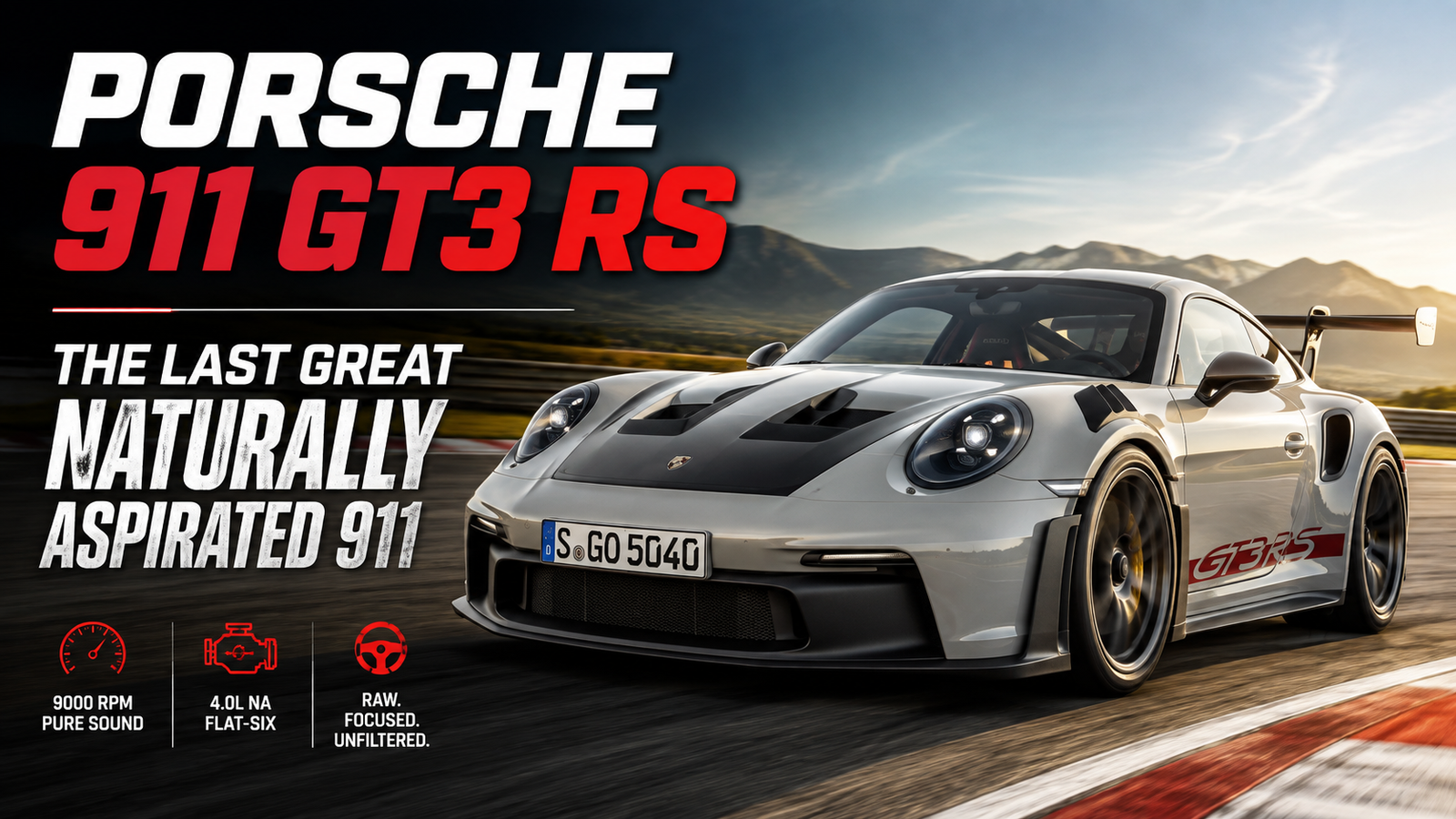
Porsche 911 GT3 RS: The Last Great Naturally Aspirated 911

Porsche’s most focused naturally aspirated 911 arrives with active aerodynamics borrowed from its GT racing programme — and almost no compromise for the road.

The short answer

The 2026 Porsche 911 GT3 RS is a track-focused, naturally aspirated 911 producing 518 hp at 8,500 rpm and 409 kg of downforce at 200 km/h. It costs approximately ₹3.5 crore ex-showroom in India and is best suited to owners with track days already booked.

Key Takeaways

  • Double-wishbone front suspension replaces struts, sharpening turn-in noticeably.
  • 409 kg of downforce at 200 km/h — roughly double the previous GT3 RS.
  • No usable boot space: the central radiator now occupies the nose.
  • 518 hp at 8,500 rpm from a 4.0-litre flat-six, with no turbocharging.
  • 0–100 km/h in 3.2 seconds, but the lap time comes from the aero, not the engine.

Aerodynamics That You Can Actually Feel

The changes start with the front axle, where double-wishbone geometry replaces the outgoing struts — a change that shows up immediately in how quickly the nose settles after a mid-corner correction. It is the single most consequential engineering decision Porsche made with this car, and it is the reason the RS feels calmer at nine-tenths than the standard GT3 does at eight.

At 200 km/h the car generates 409 kg of downforce, roughly double the previous generation. On the Buddh International Circuit’s back straight that translates into a braking point you keep moving later, lap after lap, until you run out of nerve rather than grip.

What It Costs You Every Day

The central radiator moved to the nose to free airflow for the aero package, and it took the luggage compartment with it. There is nowhere to put a helmet bag. The ride, on the softest damper setting, is firm but not punishing on a well-surfaced highway; on a broken city road it is exactly as uncompromising as you would expect.

Fuel consumption on our test loop settled at 6.4 km/l with mixed driving, and the tyres — Michelin Pilot Sport Cup 2 R as standard — will not last a full season if you use the car as intended.

The Verdict

This is not a car that rewards being bought as an investment and parked. It rewards being driven badly at first and then progressively better, because every one of its systems is calibrated to make a competent driver faster rather than to flatter an incompetent one. If you have track days in the diary, nothing else at this price gets closer to a racing car you can legally drive home.

The GT3 RS is the rarest kind of fast car — one that gets easier to drive quickly the harder you push it.

Priya Sharma

The aero is doing work you can feel through your palms, not just work you can read on a spec sheet.

Aarav Mehta

Technical Specifications

Engine 4.0-litre flat-six, naturally aspirated
Power 518 hp @ 8,500 rpm
Torque 465 Nm @ 6,300 rpm
Transmission 7-speed PDK, rear-wheel drive
0–100 km/h 3.2 seconds
Top speed 296 km/h
Downforce 409 kg at 200 km/h
Kerb weight 1,450 kg
Price (India) ₹3.5 crore approx., ex-showroom

Frequently Asked Questions

Q1 How much does the Porsche 911 GT3 RS cost in India?

Approximately ₹3.5 crore ex-showroom before options, which most buyers push well past ₹4 crore.

Q2 Is the GT3 RS usable on Indian roads?

Yes, with caveats. The front axle lift clears most speed breakers, but the ride is firm and there is no usable luggage space.

Q3 Is the GT3 RS naturally aspirated?

Yes. It uses a 4.0-litre flat-six with no turbocharging, revving to 9,000 rpm.

Q4 Is it faster than a Turbo S around a circuit?

Around most circuits, yes — the downforce and braking stability outweigh the Turbo S’s power advantage.

Priya Sharma
Senior Road Test Editor

Priya Sharma

Priya has been testing cars for Indian buyers for eleven years, first for a national daily and now as Auto Indian’s senior road test editor. She runs our instrumented testing programme.

Comments

0
A

Comments are reviewed by an editor before they appear.